
Choose DTG for small, highly detailed runs where the design has gradients, photo elements, or many colors. Choose screen printing once your order climbs past the 25 to 50 piece range with simpler, spot-color art. The break-even point shifts with color count and shop pricing, but the core trade-off stays the same: DTG wins on flexibility and detail, screen printing wins on cost-per-unit and toughness at scale.
TL;DR:
- Screen printing becomes more cost-effective than DTG for orders exceeding about 25 to 50 shirts, especially with fewer colors and straightforward designs.
- DTG is better suited for complex, detailed artwork, such as gradients or photo images, and is ideal for small batches or one-off customizations.
- Both methods' durability depends heavily on proper curing, ink type, and washing habits, with modern DTG approaching screen printing's lifespan in many cases.
- Dark garments require additional prep steps for both methods, increasing costs; DTG's pretreat adds labor and expenses proportional to order size.
- For large quantities, especially with simple, limited-color art, screen printing offers lower per-unit costs once setup is complete.
Table of Contents
- DTG vs. Screen Printing: A Side-by-Side Look
- What Will DTG or Screen Printing Actually Cost You?
- How Long Do DTG and Screen Prints Actually Last?
- Which Method Handles Your Artwork and Fabric Best?
- How Fast Can You Actually Get Your Order?
- Which Method Creates Less Waste?
- How Do You Decide Between DTG and Screen Printing?
- How Bebe Fashion Decides Which Method to Use
- An Editorial Take on Choosing Prints for Small Brands
- Shop Tattoo-Inspired Apparel Printed the Right Way
- Sources
DTG vs. Screen Printing: A Side-by-Side Look
Direct-to-garment printing, or DTG, works like an inkjet printer for fabric. It sprays ink straight onto the shirt, layer by layer, which is why it handles photorealistic art and gradients that would be nearly impossible with traditional methods. Screen printing pushes ink through a stencil (the "screen") for each color, which makes it fast and cheap once the screens exist, but expensive to set up for a single design.
Here's how the two stack up across the factors that actually drive a buying decision:
- Best for: DTG suits one-offs, sample runs, and print-on-demand orders. Screen printing suits bulk orders with repeat designs.
- Setup cost: DTG needs almost none beyond loading a digital file. Screen printing requires burning a screen for every color in the design, which adds labor and material cost before the first shirt prints.
- Cost per unit: DTG holds a flat per-item cost whether you order 1 or 40. Screen printing costs more per shirt on short runs but drops sharply past the break-even point.
- Design and detail: DTG reproduces gradients, fine lines, and full-color photos. Screen printing handles bold, limited-color art best, since each additional color means another screen.
- Durability: Both can last through heavy wear when produced correctly, though screen printing's thicker ink layer has traditionally held up better over time.
- Fabric compatibility: DTG performs best on cotton and high-cotton blends, since the ink needs natural fiber to absorb into. Screen printing, especially with plastisol inks, works across a wider range of substrates, including many synthetics.
- Turnaround: DTG ships fast for small batches since there's no setup lag. Screen printing needs setup time up front but moves quickly once the press is running.
Dark garments add a wrinkle for DTG. Printing on black or navy fabric requires a white underbase layer and a pretreat step so colors show up correctly, and that adds both material cost and drying time. Screen printing sidesteps this with an opaque underbase of its own, but it too needs an extra screen and pass for dark fabric work. Neither method is "free" on dark shirts. Both just charge for it differently.
What Will DTG or Screen Printing Actually Cost You?
Total cost breaks into two buckets: setup costs and variable, per-unit costs. Screen printing carries almost all its cost up front. Each color needs its own screen, and burning those screens takes shop time regardless of whether you order 10 shirts or 500. DTG flips that model. There's no screen to burn, but ink and pretreat costs apply evenly to every single piece, so the price per shirt barely moves no matter the quantity.
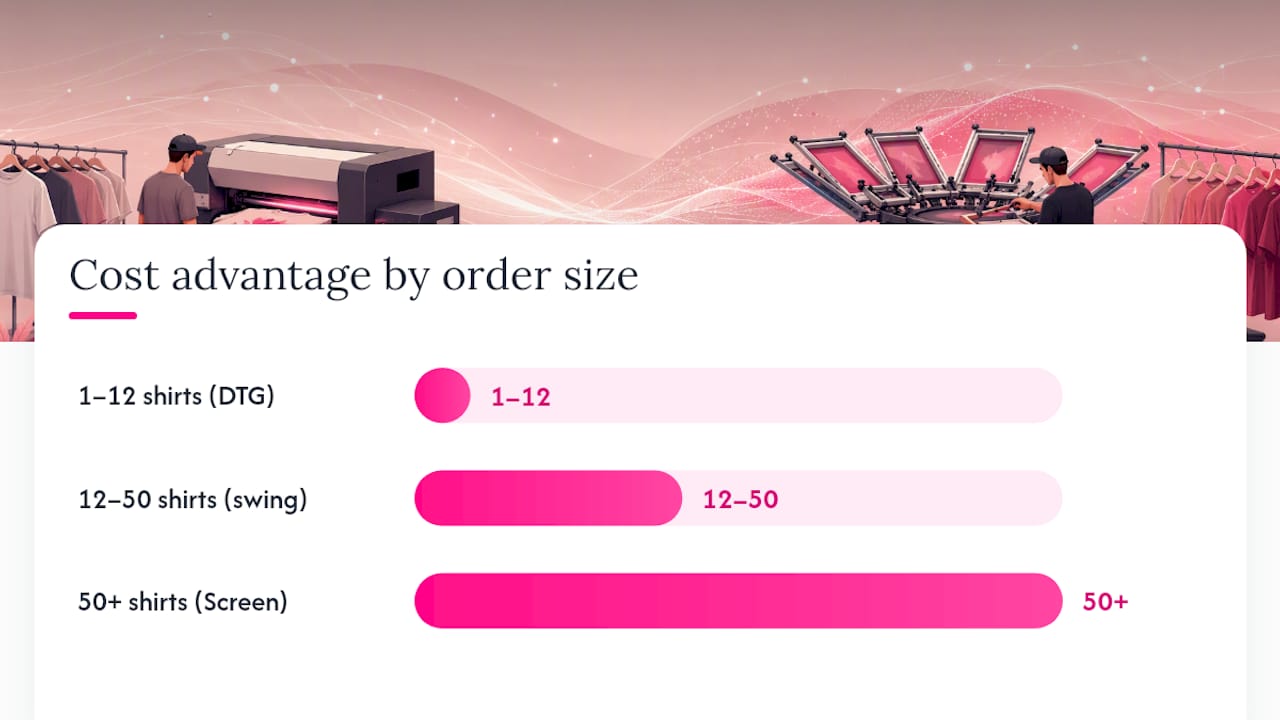
Statistic callout: Many shops in the trade cite a break-even range of roughly 12 to 50 units where screen printing starts beating DTG on price, and some print shops advise against screen printing altogether for orders under about 24 shirts because setup costs eat the margin on small multi-color jobs.
Rough scenarios help make this concrete:
- 1 to 12 units: DTG almost always wins. Screen printing's setup labor makes tiny orders expensive per piece, even for a one-color logo.
- 12 to 50 units: This is the swing zone. Simple, one- or two-color art starts favoring screen printing; complex, multi-color or photo art still favors DTG.
- 50-plus units: Screen printing typically pulls ahead here, especially with fewer colors, since the setup cost spreads across so many shirts that it barely registers per unit.
Hidden costs sneak into both methods. DTG shops absorb printhead maintenance, ink cartridge replacement, and pretreat machine upkeep. Professional DTG systems alone can run into the tens of thousands of dollars for the equipment, which shows up eventually in per-piece pricing. Screen printers deal with screen reclamation fees, ink waste during setup, and the labor of registering multiple screens correctly. Neither method is "hidden cost free." Ask your printer directly what's baked into their quote before you compare two numbers side by side.
How Long Do DTG and Screen Prints Actually Last?
Both methods can produce a print that survives years of washing, but they age differently, and how they're cured matters more than which machine touched the shirt. Screen-printed designs tend to sit on top of the fabric in a slightly raised layer, which gives them a distinct texture you can feel and often see. That thicker ink layer has historically given screen printing an edge in wash durability, particularly on high-friction areas like sleeves and hemlines.
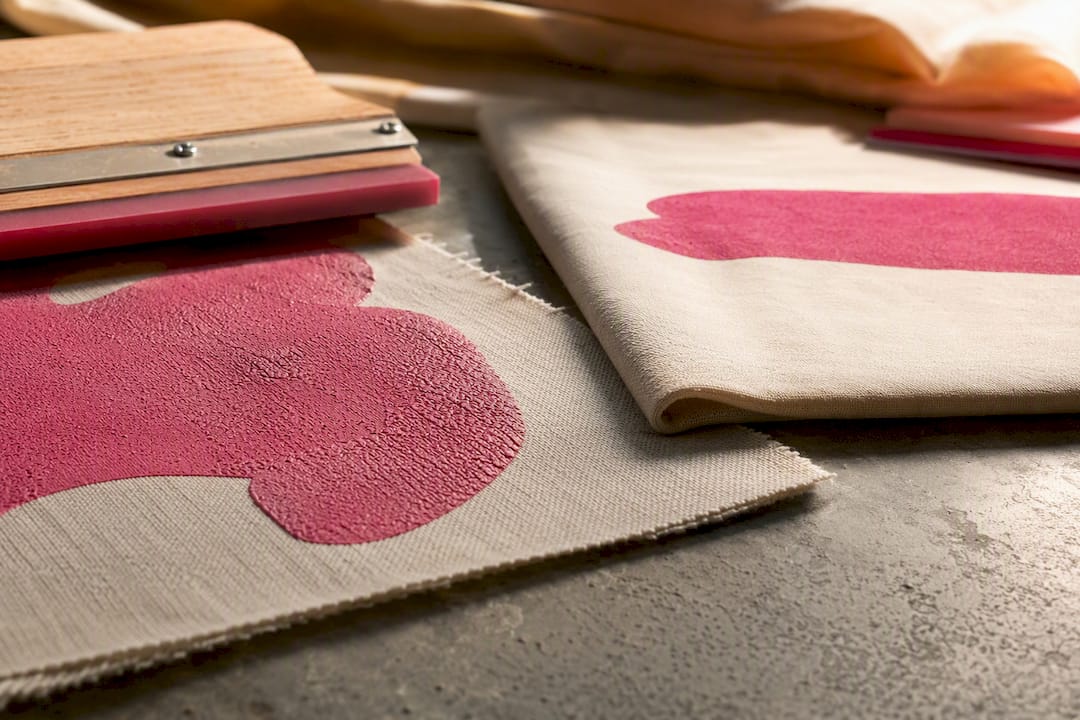
DTG ink absorbs into the fibers instead of sitting on top, which produces a softer hand feel, almost like the design was dyed rather than printed. Modern industrial DTG systems have closed much of the durability gap, and some setups now approach screen-print longevity in real-world use. So, treating screen printing as automatically longer lasting oversimplifies the comparison. Curing is the real variable behind both. Under-cured ink, whether DTG or plastisol, cracks and fades fast regardless of method.
What actually determines lifespan:
- Full, correct curing temperature and time during production.
- Ink type: water-based DTG inks vs. plastisol or specialty screen inks behave differently under heat and wash cycles.
- Wash habits: cold water and inside-out drying extend any print's life.
- Fabric quality: a cheap, thin shirt fails before the print does.
Pro Tip: Turn printed garments inside out before washing and skip the dryer's high-heat setting. That single habit adds real years to either printing method.
Which Method Handles Your Artwork and Fabric Best?
Match the printing method to your artwork before you match it to your budget, because the wrong choice here can't be fixed with more money later. DTG shines when a design has gradients, drop shadows, fine text, or photographic elements. It applies unlimited colors at no extra cost, since there's no screen count to worry about. It performs best on cotton and cotton-blend garments where ink can properly absorb into the fiber.
Screen printing handles bold, flat-color artwork with the fewest headaches, and it opens the door to specialty effects DTG can't touch.
- Metallic, glow-in-the-dark, and puff inks are screen-printing options with no DTG equivalent.
- Screen printing works across a broader range of fabrics, including many synthetic blends that resist DTG ink absorption.
- Dark garments need a white underbase in both methods, but DTG's pretreat step adds a cost and labor layer that scales with order size.
- Simple one- or two-color logos almost always print more economically on a screen press.
How Fast Can You Actually Get Your Order?
DTG's speed advantage lives in the absence of setup. A single shirt can print within minutes of hitting "start," which makes it the right call for a rush order or a same-week custom gift. Where DTG loses ground is linear scaling: printing 200 identical shirts still means printing 200 individual passes, one at a time, with no shortcut.
Screen printing flips that math entirely. The setup, registering screens and dialing in ink, eats real time up front. Once the press is running, though, an automated multi-station press can push out shirts far faster per piece than DTG ever will, since one screen pass covers the whole design regardless of quantity.
- Same-week one-offs or gifts: DTG is the practical choice; no setup lag, no minimum order.
- Small-batch collections (a few dozen pieces): Depends on color count and deadline flexibility. DTG if the art is complex or the timeline is tight.
- Large seasonal or bulk runs: Screen printing, especially with an automated press, delivers far higher throughput once setup is done.
Which Method Creates Less Waste?
Sustainability tends to get overlooked until a buyer asks the right question, and the two methods differ meaningfully here. DTG generally produces less waste because it prints only what's ordered. That supports print-on-demand models where nothing gets made until a customer buys it, cutting the overproduction risk that haunts traditional apparel manufacturing. DTG also typically uses water-based inks, which tend to generate less harmful wastewater than older ink chemistries.
Screen printing has historically used more water and chemicals, particularly during screen cleaning and reclamation, though eco-conscious shops now offer water-based or discharge inks and better reclaiming processes to reduce that footprint.
Questions worth asking any printer before you order:
- What ink chemistry do you use, and is it water-based?
- How do you handle screen reclamation and wastewater?
- Can you produce on demand, or do I need to commit to a minimum inventory?
How Do You Decide Between DTG and Screen Printing?
Three questions settle most decisions. First, how many pieces are you ordering, and does that number sit above or below the roughly 25 to 50 unit range where screen printing starts winning on price? Second, how complex is your artwork, and what fabric is it going on? Photo-level detail or a synthetic blend points toward DTG; bold spot colors on cotton point toward screen printing. Third, how long does this print need to last, and how fast do you need it in hand?
Run through this before placing any order:
- Confirm your total order size and compare it against the shop's own break-even pricing.
- Pin down artwork complexity: count the colors, check for gradients or photo elements.
- Identify your fabric: cotton favors DTG, synthetic blends often favor screen printing.
- Set your real deadline, not your ideal one.
- Ask the printer directly about curing process, ink type, and wash-durability testing.
Pro Tip: When in doubt, request a printed sample swatch before committing to a full order, especially for a first-time design or an unfamiliar fabric blend.
How Bebe Fashion Decides Which Method to Use
The company builds tattoo-inspired apparel around detailed, illustrative artwork: fine line work, shading, and multi-color flash designs drawn from traditional tattoo art. That style leans naturally toward DTG for most limited runs, since the gradients and linework in a piece like the Dragon & Crane Graphic Tee need the resolution DTG delivers.
Heavier garments meant for repeat inventory, like the Traditional Tattoo Moth & Rose Hoodie, sometimes shift toward screen printing when a design proves popular enough to justify a bulk run.
- Small-batch, detailed flash art: DTG.
- Repeat-selling hoodies and sweatshirts: screen printing, once demand supports it.
- Customers curious about a specific item's print method can reach out directly through the storefront for details.
An Editorial Take on Choosing Prints for Small Brands
Detail wins arguments that price alone can't settle. For a design-led brand working with fine linework and shaded tattoo flash art, DTG usually earns the nod for limited editions, not because it's cheaper, but because a screen press physically can't reproduce a soft gradient the way a digital printhead can. The softer hand feel that comes with DTG also just fits apparel meant to feel worn-in from day one.
Screen printing still earns its place for hoodies and anything moving into repeat production, where the thicker ink and lower per-unit cost make more sense once a design proves it can sell in volume. If there's one habit worth building as a shopper or a small brand owner, it's this: decide on quantity and durability needs before falling in love with a specific method. The artwork usually tells you which one fits anyway.
— Bebe
Shop Tattoo-Inspired Apparel Printed the Right Way
The company sells tattoo-inspired, customizable apparel and accessories, from flash-style hoodies to graphic tees and totes, built around traditional tattoo art. Every product page lists fabric and fit details, and if you're curious how a specific piece is printed, reaching out before you buy takes thirty seconds and saves a return later.
Browsing for something with real texture and detail? The Sparrow Flash Tattoo Hoodie shows off the kind of fine banner and floral linework that benefits from careful print selection rather than a one-size-fits-all process. Check current stock and sizing on the Bebe Fashion storefront and message the team directly if you have questions about print method, care instructions, or customization options before you check out.
Sources
- DTG vs. Screen Printing | Pros, Cons, How Much It Costs - Printavo
- DTG vs. Screen Printing: Factors to Consider for Your Brand (2025) - Shopify
- DTG vs Screen Printing | Printify